
Real-time financial risk visibility across every counterparty and debt obligation
Monitor counterparty payment patterns and debt obligations in real time from a single platform. TellMe, our treasury AI, tracks DSO and DPO from actual invoice data, reconciles bank charges against agreed terms, and flags deviations before they escalate.
Trusted by 500+ corporate finance teams including





Smarter risk management for finance teams
Financial risk isn't abstract — it's a client paying 15 days late, a bank overcharging on a variable-rate loan, or an unverified IBAN on a supplier payment. Embat surfaces these risks before they escalate.
Risks caught before they escalate
Payment delays, unusual bank charges, and deteriorating counterparties flagged early with full context. Your team acts on verified deviations, not month-end surprises discovered too late to prevent impact.
Verified charges, not assumed accuracy
Every bank charge on every debt instrument reconciles against agreed terms automatically. Discrepancies surface the moment they occur, replacing the manual investigation that follows each mismatch.
Group-wide exposure in one view
See how the same counterparty behaves across every entity and how debt obligations distribute across banks and currencies. Consolidated visibility replaces the per-entity spreadsheets that hide concentration risk.
Operational hours returned to strategy
Automatic DSO and DPO calculations, real-time aging reports, and automated amortisation schedule tracking eliminate the manual data gathering that consumes the first days of every month.
How Embat transforms your risk management
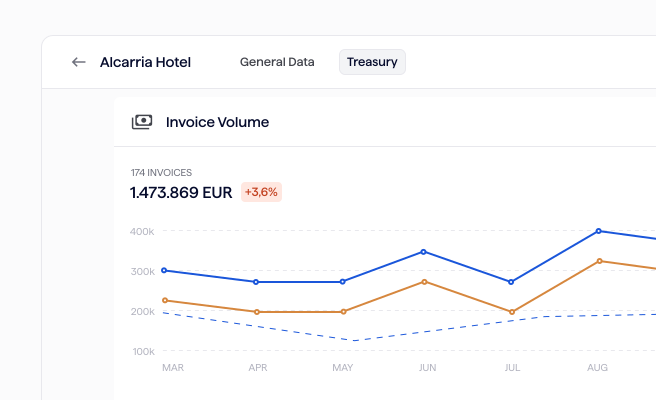
Know exactly how every client and supplier behaves across all entities
Centralise all counterparty data and monitor payment behaviour with real-time DSO, DPO, and aging calculated from actual invoices. Pre-validated IBANs and read-only ERP fields protect against payment fraud. Proactive alerts flag deteriorating accounts before overdue balances escalate, giving your team the evidence to act with confidence.
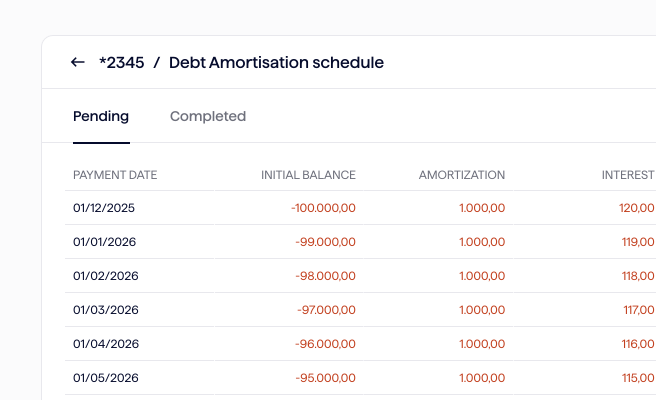
Every loan, lease, and credit line centralised and reconciled
Manage your complete debt portfolio from one platform, with automated amortisation schedules that track variable rates and recalculate at every reset date. Bank charges reconcile against agreed terms instantly, and all obligations feed directly into your cash flow forecast. Finance teams gain full visibility of upcoming maturities and debt walls before they create liquidity pressure.
One platform. Every bank. Full control.
Actual results from real financial teams
This is how teams already using Embat describe the change.


"Previously, 100% of one team member's time was spent on manual tasks. Today, one person can manage daily treasury in real time, spending only 10–15% of their time on it, freeing up resource for value-added work."Javier Gaya - CFO at HOFF


"If you apply a dose of AI to this, the result is highly promising and exciting. Embat's Treasury and Accounting solution is perfect for our organisation."Ángel López, CFO, Grupo CPS


"We manage a wide range of B2C, B2B, and B2G transactions with customers in 60 countries. With Embat, we have been able to bring the month-end close forward by more than 4 days and we have centralised payments, reducing the time per transaction from 10 minutes to a matter of seconds."Ignacio Marcos Pérez, CFO, thePower


"A Treasury Management System makes sense if it enables the Treasury Manager and Corporate Finance to have clear visibility across three levels: the actuals, confirmed forecasts, and an estimated forecast for strategic decisions. For us, Embat has been the solution that ensures clarity across those three levels."Michele Laria, Corporate Finance Director, Molins

Ready to transform your treasury operations?
Automate, centralise, and make smarter decisions in real time. See how Embat can save your finance team up to 75% of their time, reduce errors, and boost productivity.
Frequently Asked Questions
Financial risk management in corporate treasury covers the processes finance teams use to monitor, measure, and control exposure to counterparty default and debt obligations. In practice, this means tracking who owes you money and how reliably they pay (counterparty risk), alongside managing what you owe banks — loans, credit lines, leasing agreements — and verifying that charges match agreed terms (debt risk). For growing companies with multiple entities, the challenge multiplies: the same counterparty may behave differently across subsidiaries, and debt instruments spread across banks without a consolidated view. Effective risk management replaces month-end discovery with real-time visibility. Ask us in your demo how this works in practice.
Embat connects bidirectionally with major ERPs including SAP, Oracle NetSuite, Microsoft Dynamics 365, and Sage Intacct. Counterparty records, invoice data, and payment terms sync automatically. Fields sourced from the ERP are read-only in Embat to prevent data conflicts. Debt instruments integrate through banking connections and sync GL postings back to your ERP. Standard connectors deploy in 2-3 weeks for major ERPs, and your team continues using the ERP normally during setup.
Tracking counterparty risk across a group requires consolidating payment behaviour data from every entity into one view. The key is calculating DSO and DPO from actual paid invoices — not contractual terms — so you see how each client and supplier truly behaves. Aging buckets should update continuously, and deviations from historical patterns should trigger alerts before balances become overdue. Embat centralises counterparty profiles from your ERP, calculates these metrics automatically across all entities, and flags deterioration in real time. Finance teams using this approach reduce overdue receivables by 22% on average and catch payment delays 10–15 days earlier.
Automating amortisation schedules means replacing the "master debt Excel" with a platform that generates schedules, tracks variable rate resets (EURIBOR, €STR), and recalculates outstanding periods automatically when new rates arrive. The real value comes when each bank charge reconciles against the schedule instantly — discrepancies between what was agreed and what the bank actually charges surface without manual investigation. Embat supports fixed and variable rate instruments, imports custom schedules from Excel, and posts GL entries automatically, splitting principal, interest, and tax across configured accounts. All obligations feed directly into cash flow forecasts in real time.
A well-designed integration is bidirectional: counterparty records, invoice data, and payment terms flow from the ERP into the risk management platform, while reconciliation results, GL postings, and updated payment statuses sync back automatically. Fields sourced from the ERP should be read-only to prevent data conflicts. Embat connects with SAP, Oracle NetSuite, Microsoft Dynamics 365, Sage Intacct, and 20+ other systems through pre-built connectors that deploy in 2–3 weeks. Debt instruments integrate through direct banking connections, and your team continues working normally during setup.
Contractual DSO assumes every client pays on the date their terms specify — 30, 60, or 90 days. Actual DSO measures when invoices are really paid, based on historical settlement data. The gap between the two is where liquidity surprises live: a forecast built on contractual terms shows cash arriving on day 30, but the client consistently pays on day 45. That 15-day gap, multiplied across your client base, creates invisible liquidity shortfalls. Embat calculates DSO from actual paid invoices and TellMe enriches cash flow forecasts with real payment patterns, closing the gap between what you expect and what actually happens.