
Approve, sign, track, and reconcile Corporate Payments quickly and securely
Centralise payment preparation, route approvals to the right people, and execute across all your banks without switching portals. Every payment carries full traceability, from ERP invoice to bank confirmation to GL posting, with real-time visibility into your cash position before, during, and after execution.
Trusted by 500+ corporate finance teams including





Complete payment control
from preparation to GL posting
All payment types, one workflow
AP payments, payroll, tax remittances, direct debits, ad-hoc transfers, and international wires all flow through the same approval chain and bank connections. Files generated by external systems transmit without their content being extracted or displayed.
Approve from any device
Review full invoice context and sign payments from desktop or mobile with multi-factor authentication. Approvers act on pending items without waiting to be at their desk or carrying bank-specific hardware tokens.
Multi-entity governance
Manage approval policies for all your legal entities from one central configuration. Each entity follows its own rules (amount thresholds, joint signatures, tiered limits) while finance leadership maintains visibility across the group.
Real-time balance visibility
Check available balances across all accounts before executing payments. Cash position updates reflect pending outflows, so payment decisions account for actual liquidity, not stale portal data.
Full audit trail
Every action (preparation, approval, rejection, execution, reconciliation) is logged with timestamp, user identity, and full invoice context. One record per payment replaces the reconstruction of history across email threads, bank logs, and spreadsheets.
Coexists with your existing banks
Centralisation adds a control layer on top of your banks; it does not replace them. Your accounts, credit lines, and commercial terms stay exactly as they are.
Three capabilities that cover the full payment lifecycle
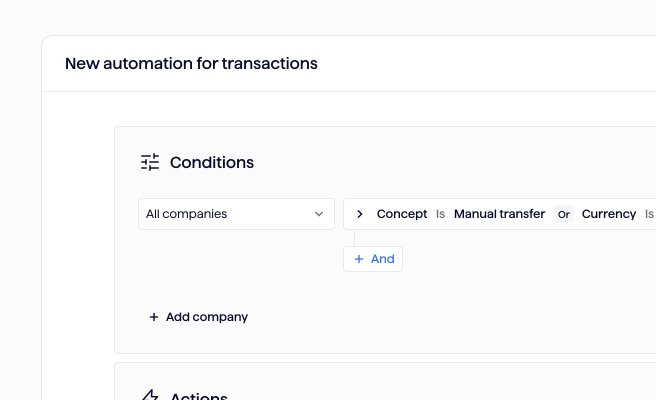
Generate, validate, and execute payment files across every bank without manual uploads
Payments pull structured data from your ERP (supplier, amount, currency, bank details) and run through validation checks that catch incorrect IBANs, format errors, and missing fields before any file reaches the bank. Files generate in each bank's required format (pain.001, MT101, MT103) and transmit through direct connections: Corporate API, H2H, EBICS, SWIFT, or EDITRAN. Bank confirmations match against your GL entries to close the reconciliation loop automatically.
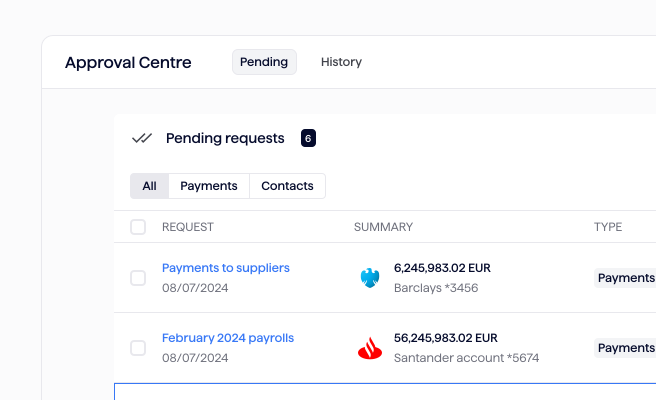
Route every payment through configurable approval logic with full fraud visibility
Configure approval rules by amount, entity, payment type, or any combination. Approvers review full invoice context from desktop or mobile, and if anyone edited beneficiary data after it left the ERP, a warning banner shows exactly what changed and who changed it. One authentication covers all banks and entities, replacing separate signing sessions at each portal. Reject individual invoices from a batch without holding up the rest.
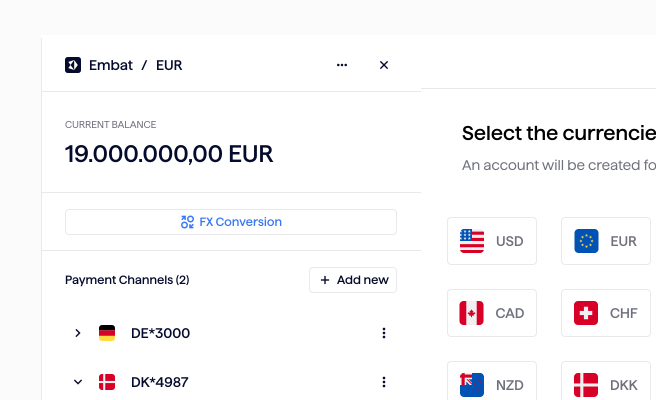
Execute and reconcile international payments with local clearing and automatic FX accounting
A global banking account complements your existing bank pool for international payments, with multi-currency balances, local clearing instead of SWIFT where possible, and visible FX costs before execution. Every currency conversion generates the corresponding journal entries (fees, spreads, realised gains and losses) posted automatically to your ERP. Digital onboarding completes in days, not weeks, with no file-based integration or IT resources required.
The intelligence behind Embat
What does TellMe do?
Everything your finance department needs:
Payment data completion
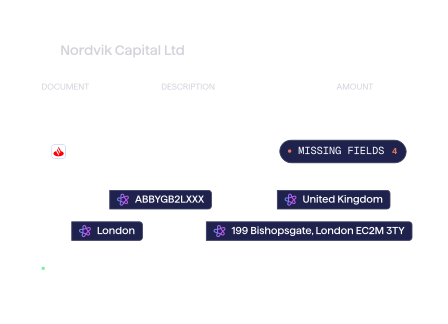
Complete payments instantly: TellMe fills in the missing beneficiary data
As you build your payment batches, TellMe detects incomplete records in real time and suggests the missing beneficiary data on the spot. Keep your payment workflow moving without interruptions or manual lookups.
One platform. Every bank. Full control.
Actual results from real finance teams
This is how teams already using Embat describe the change.


"Previously, 100% of one team member's time was spent on manual tasks. Today, one person can manage daily treasury in real time, spending only 10–15% of their time on it, freeing up resources for value-added work."Javier Gaya - CFO at HOFF


"If you apply a dose of AI to this, the result is highly promising and exciting. Embat's Treasury and Accounting solution is perfect for our organisation."Ángel López, CFO, Grupo CPS


"We manage a wide range of B2C, B2B, and B2G transactions with customers in 60 countries. With Embat, we have been able to bring the month-end close forward by more than 4 days and we have centralised payments, reducing the time per transaction from 10 minutes to a matter of seconds."Ignacio Marcos Pérez, CFO, thePower


"A Treasury Management System makes sense if it enables the Treasury Manager and Corporate Finance to have clear visibility across three levels: the actuals, confirmed forecasts, and an estimated forecast for strategic decisions. For us, Embat has been the solution that ensures clarity across those three levels."Michele Laria, Corporate Finance Director, Molins

Ready to see what automated Corporate Payments can do for you?
Book your personalised demo to see how you can centralise payments, automate approvals, and transform your finance operations in weeks, not months.
Frequently Asked Questions
Corporate payment management covers the full lifecycle of outgoing business payments, from invoice preparation and internal approval through bank execution and post-payment reconciliation. In mid-market companies, this process typically spans multiple bank portals, disconnected approval chains (often via email), and manual GL matching after the fact. A centralised payment management platform replaces that patchwork with a single workflow where data flows from ERP to bank to ledger without manual handoffs.
The answer depends on how the platform connects. File-based protocols like H2H, EBICS, SWIFT/FIDES, and EDITRAN cover most corporate banking relationships in Europe. Corporate API connections provide real-time communication with banks that support them. The key question when evaluating any platform is whether it supports the specific banks and protocols your company already uses, not just a headline number of supported institutions.
A well-integrated platform reads AP data from your ERP and writes back payment confirmations, journal entries, and document liquidations. The ERP remains your system of record — nothing changes in how your team works there. The integration runs in parallel during setup, so there is no disruption to ongoing operations. The critical question is whether the integration is bidirectional (data flows both ways) or one-directional (export only), as this determines whether post-payment accounting is manual or automatic.
Centralisation actually reduces risk compared to the alternative. When payment files are generated and transmitted in the backend, no one downloads, edits, or uploads files manually, removing the step where files are most vulnerable to manipulation. Multi-factor authentication, role-based access, and approval workflows enforce governance consistently. Look for ISO 27001, SOC 2 Type II, and backend file generation as minimum requirements when evaluating any payment platform.
Yes. Centralisation adds a control layer on top of your banks; it doesn't replace them. Your bank accounts, credit lines, and commercial terms stay exactly as they are. The platform connects to each bank through the protocol that bank supports and orchestrates the payment process from one interface. For international payments beyond what your banks offer, some platforms also provide global banking accounts that complement your existing pool.
Timelines depend on how your banks connect. Pre-built Corporate API integrations can be live in days. File-based connections (H2H, EBICS, EDITRAN) require coordination with your bank and typically take 2-6 weeks per connection. ERP integration runs in parallel. The total implementation for a company with 3-5 bank relationships is typically 4-6 weeks from kickoff to production.