
Global banking that executes, reconciles, and books international payments to your ERP in one workflow
Open global bank accounts in days, connected to your ERP from day one. Prepare, execute, and reconcile international and cross-border payments from the same platform where you manage your treasury, with no bank connections to configure and no files to generate. Payments clear locally, FX books automatically to your ledger, and every transaction reconciles against the original ERP invoice on settlement.
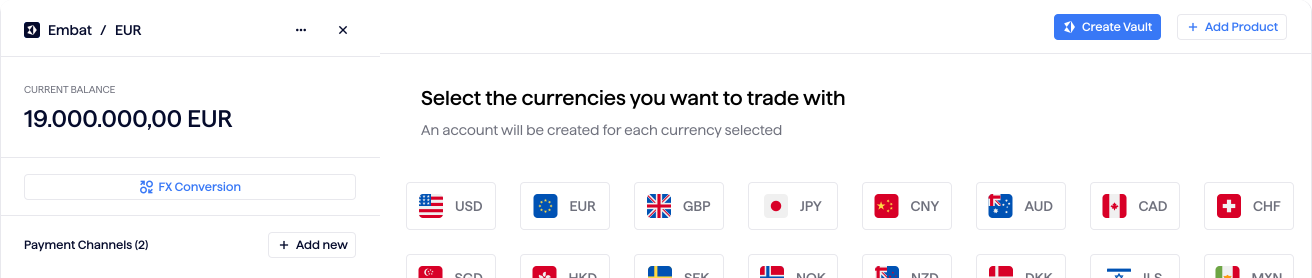
Execute international payments from your ERP to any country without touching a banking portal
Invoice data syncs from your ERP and populates payment instructions automatically
Your ERP feeds invoice and beneficiary data into Embat through native bidirectional integration. Payment instructions populate automatically with the correct currency, amount, and beneficiary details — no manual re-entry across systems, no file exports, no copy-paste errors.
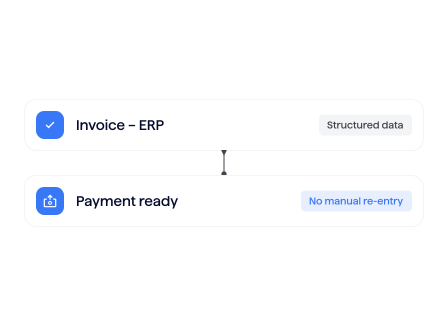
Approval flows work exactly like your domestic payments
The same configurable multi-level approval workflows apply to international payments. Approvers review, reject individual invoices, or sign entire batches from desktop or mobile with MFA — regardless of destination country or currency.
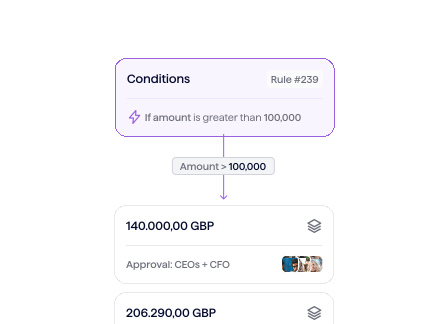
Payments execute with local clearing in the destination country
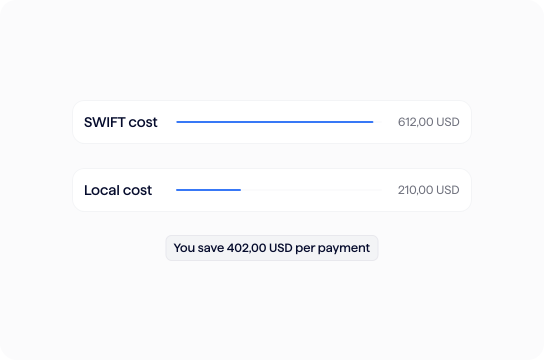
Instead of routing every international payment through SWIFT, the global banking account uses local clearing networks wherever possible. Faster settlement, lower fees, and per-transaction control — if one payment fails, the rest continue executing independently.
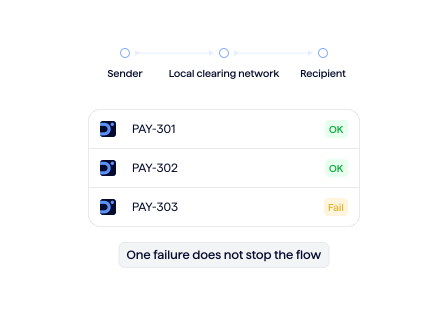
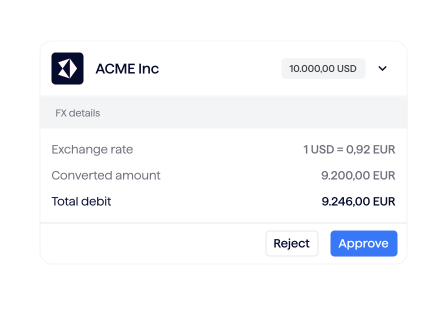
FX cost is visible before you approve the payment
The conversion rate and fee appear on-screen before execution, so the approver knows the total cost before signing. No hidden spreads, no post-payment surprises on the bank statement.
Reconciliation and FX booking happen automatically on settlement
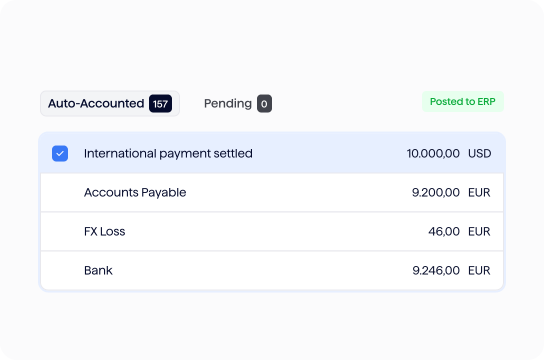
Each payment reconciles against the original ERP invoice on settlement. FX fees, spreads, and currency gains or losses post automatically as journal entries in your general ledger, and documents liquidate in your ERP — eliminating the manual accounting work that follows every international payment.

One global account that replaces the complexity of international bank relationships
Multi-currency accounts
Hold balances in multiple currencies from a single account. Fund once, pay locally — without separate banks in each country or currency.
Local clearing worldwide
Payments route through local clearing networks instead of SWIFT wherever possible, reducing fees and settlement times. FX cost is visible before execution.
Account opening in days
Fully digital onboarding completes in days, not weeks. New accounts connect to your ERP from the start, so payments and accounting work automatically the moment the account is live. No file-based integration, no Editran setup, no H2H configuration, no IT resources required.
Deep ERP integration
Native bidirectional sync with SAP Business One, SAP S/4HANA, SAP ECC, NetSuite, Business Central, Sage, and DATEV. Invoice data flows in; reconciliation results and journal entries flow back.
Automatic FX accounting
Every currency conversion generates the corresponding journal entries — fees, spreads, realised gains and losses — posted automatically to your ERP general ledger.
Coexists with your existing banks
The global banking account complements your current bank pool. Use it for international payments while domestic payments continue through your existing banks via Embat's direct bank connections.
The measurable impact of a single international payment workflow
60+ currencies across 150+ countries
Multi-currency payments execute with local clearing where available, reducing reliance on SWIFT intermediaries and shortening settlement times. One platform for all your multi-currency payments.
10 hours per week saved on GL bookings
Automatic FX accounting eliminates the manual journal entries that follow every international payment — fees, spreads, and currency differences post automatically.
70% reduction in payment processing time
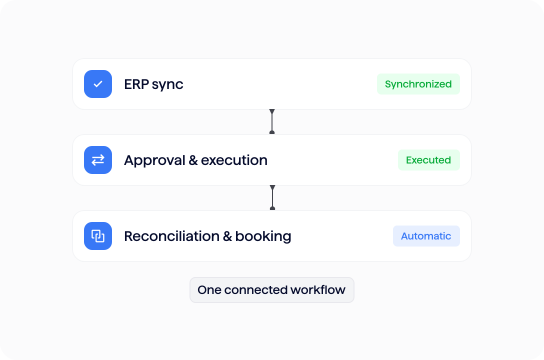
One workflow from ERP to execution replaces the cycle of file generation, portal login, manual entry, and post-payment reconciliation across multiple banking systems.
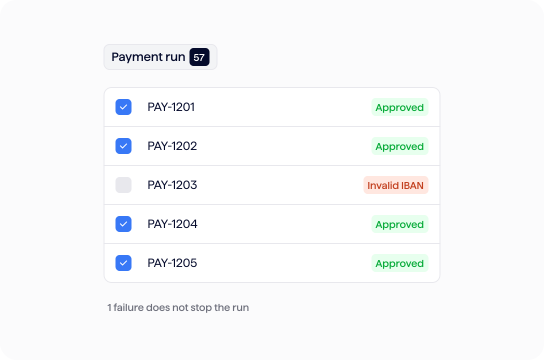
Per-transaction control instead of batch risklete audit trail per payment
Individual payment resolution means one error never blocks the rest of your payment run. Exceptions resolve independently without re-approving or regenerating entire batches.

Ready to see what an Intelligent Treasury can do for you?
Book a demo tailored to your specific challenges and see how Embat can transform your finance operations in weeks, not months.
Frequently Asked Questions (FAQ)
Embat offers two models for executing corporate payments. Direct bank execution connects to your existing banks through file-based protocols (Editran, EBICS, H2H, SWIFT/FIDES) or Corporate API — your money stays in your bank accounts, and Embat orchestrates the payment process.
Global banking is a different model: you open an Embat-managed bank account where you can hold balances and execute payments in multiple currencies across a broad range of countries. Payments route through local clearing networks instead of SWIFT, which means faster settlement and lower fees. Your funds are held in safeguarding accounts at major global banks, legally segregated and protected.
Both models share the same preparation and approval workflow — ERP sync, configurable approvals, MFA signing, audit trail. The difference is in execution: direct bank execution works through your banks; global banking works through a dedicated account with built-in international capabilities.
A common deployment pattern combines both: direct bank execution for domestic payments through existing banks, and global banking for international payments and new market expansion.
Global banking uses the same native bidirectional ERP integration as the rest of the Embat platform. Invoice and beneficiary data syncs automatically from your ERP into Embat. After payment execution, reconciliation results, journal entries, and document settlements post back to your general ledger.
The key difference from direct bank execution is that FX accounting is fully automated. Every currency conversion generates the corresponding journal entries — conversion fees, FX spreads, and realised gains or losses — without manual intervention.
Supported ERPs include SAP Business One, SAP S/4HANA, SAP ECC, Oracle NetSuite, Microsoft Business Central, Sage, and DATEV. The integration works identically for both payment models, so adding global banking to an existing Embat deployment requires no additional ERP configuration.
Client funds deposited in the global banking account are held in safeguarding accounts at major global financial institutions, legally segregated from Embat's balance sheet. This means your funds are protected even in an insolvency scenario — they cannot be claimed by Embat's creditors.
The account operates under an Electronic Money Institution (EMI) regulatory framework, which requires strict fund safeguarding, capital adequacy, and ongoing compliance oversight.
All transactions are protected by the same security controls as the rest of the Embat platform: bank-level encryption (AES-256 at rest, TLS 1.3 in transit), multi-factor authentication, role-based access control, and complete audit trails. Embat is ISO 27001 certified and SOC 2 Type II compliant.
The global banking account supports balances in 60+ currencies and can execute payments across 150+ countries. Payments route through local clearing networks wherever possible, avoiding SWIFT intermediaries and reducing both cost and settlement time.
Cross-currency payments are fully supported — a capability not available through direct bank execution, where payments execute in the account currency of your existing bank. FX pricing is transparent: the conversion rate are visible before you approve the payment.
Account opening is fully digital and typically completes within days including KYC verification. There is no technical integration work required — no file-based protocols to configure, no bank-side setup, no IT resources needed.
This compares to 2-6 weeks for a typical direct bank connection (file-based or Corporate API), which requires coordination between Embat, the client's bank, and sometimes the client's IT team.
If you already use Embat for payment execution through your banks, adding a global banking account is particularly fast because your ERP integration, approval workflows, and user permissions are already configured. The account simply becomes an additional execution channel within the same platform.
Yes — global banking is designed to complement your existing bank pool, not replace it. Companies typically combine both execution models: direct bank connections for domestic payments through their established banking relationships, and global banking for international payments, new market expansion, or currencies their banks don't efficiently support.
From an operational perspective, both models share the same interface: your treasury team prepares and approves payments in Embat regardless of which execution path applies. The distinction is transparent to the approver — what changes is the underlying execution and fee structure.
This hybrid approach means you can start with global banking for your international payments today while keeping your domestic bank relationships exactly as they are. There is no migration required for your existing payment flows.
Embat executes cross-border payments in 60+ currencies across 150+ countries from one workflow, connected to your ERP. Cross-border payments route through local clearing networks instead of SWIFT wherever possible, which lowers fees and shortens settlement times, and the FX cost is visible before you approve.
Fees, spreads and FX gains or losses post to your general ledger automatically, so cross-border payments are reconciled without manual work.
Account opening is fully digital and typically completes within days, including KYC, with no technical integration work. Because the account connects to your ERP from the start, you can begin executing international payments and posting them to your ledger automatically as soon as it is live, while keeping your existing bank relationships in place.