
All your bank, ERP and PSP connectivity in one integration layer
Real-time bank feeds across 15,000+ institutions and bidirectional synchronisation with SAP, NetSuite, Business Central, and many more ERP systems — connected through a single secure gateway. Invoices, transactions, balances, and reconciled entries flow automatically between your banks, your ERP, and your payment platforms without manual intervention.

Every bank, ERP, and platform
connected from day one
An end-to-end treasury management AddOn, designed by and for finance experts, and built to support your company's growth.
Real-time via APIs. File-based when needed.
Our API-first architecture, based on open banking, ensures fast bidirectional integration with your bank feeds and ERPs, while file-based methods remain fully supported for banks and regions where APIs are not yet available.
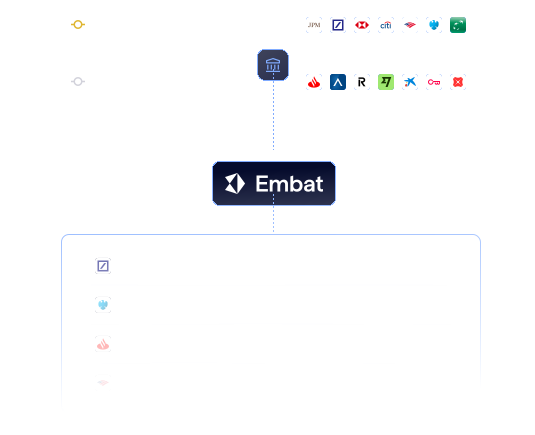
Real-time API connect
Real-time bidirectional synchronisation with your Bank Feeds and ERPs through corporate and open banking APIs, keeping balances, automated statement feeds, transactions and account information always up to date. No manual uploads, no waiting.
File-based connect
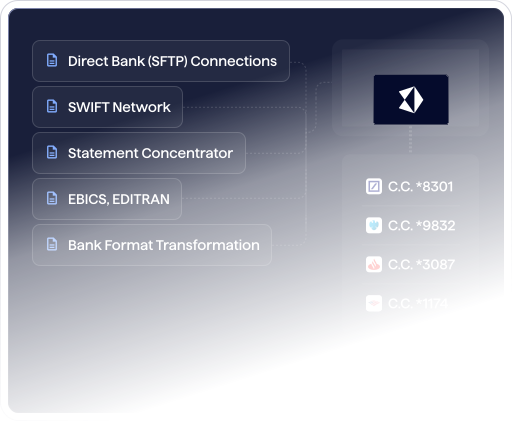
Secure direct connections with your banks to automate financial data through certified protocols such as EBICS, SWIFT, and host-to-host channels, ensuring balances, transactions, and statements are always up to date even when APIs are not available.
One-platform. All your connections.
Whether you’re operating in one country or twenty, Embat gives you a single, secure gateway to connect with every bank and platform your business needs.
ERP Connectivity
SAP
SAP ByDesign

SAP Business One

SAP S/4HANA

SAP R3

Microsoft
Microsoft Dynamics AX
Microsoft Business Central

Microsoft Dynamics F&O

Microsoft Navision

Oracle Netsuite
Oracle Netsuite

Oracle Cloud

Sage Intacct
Sage Intacct

Sage
Sage X3

Sage 200

Sage 50

Others
Workday

Odoo

Holded

Datev

Ekon

Zoho ERP

Rillet

Bank Connectivity
Barclays

Lloyds Bank

HSBC

Deutsche Bank

Wells Fargo

J.P. Morgan

Bank of America

Goldman Sachs

Citi

Societé Générale

CaixaBank

Banco Sabadell

BBVA

UBS

Abanca

UniCredit Bank AG

NatWest

Standard Chartered

DZ Bank

Santander

KFW

Morgan Stanley

Commerzbank

BNP Paribas

Crédit Agricole

Royal Bank of Canada

ING

Banking Circle

and 15,000 other banks
Payment Processors








Expense Management
Pleo

Spendesk

Moss

Payhawk

Security and Compliance

Microsoft

AWS

Okta


Centralised. Reliable. Effortless.
Built for finance teams
Forget logging into multiple platforms to check balances, download statements or upload forecasts. Embat brings your data into one place, clean, updated and ready to use.
Frequently Asked Questions about our Financial Integrations
Financial connectivity is the ability to exchange data automatically between your banks, your ERP, and your payment platforms. Without it, treasury teams depend on individual banking portals, manual statement downloads, and re-keying data between systems.
Embat centralises all these connections into a single gateway: balances, transactions, and bank statements arrive in real time, and reconciled journal entries flow back to your general ledger without manual intervention. The result is a reliable cash position updated to the minute, not to the following day.
Embat connects to 15,000+ financial institutions worldwide through open banking APIs, corporate APIs, and file-based protocols such as EBICS, SWIFT, and host-to-host. This includes both tier-1 institutions and regional banks.
The platform supports simultaneous connections across different channels, so if one bank offers API access and another only supports file-based transmission, both coexist in the same workflow without duplicating processes. Ask us in your demo which banks we connect to in your market.
Embat offers bidirectional integration with all major ERP systems: SAP (S/4HANA, ECC, Business One), Oracle NetSuite, Microsoft Dynamics 365 (Business Central, Finance & Operations), Sage, DATEV, and 20+ additional systems. Accounts payable, accounts receivable, and invoice data flow from your ERP into Embat. Journal entries, payment statuses, and reconciliation results are sent back automatically.
Synchronisation runs in near real time – event-driven, not overnight batch – so your ledger reflects financial reality throughout the day.
Not every bank offers API access, particularly in certain regions or for specific product types. Embat handles this through its hybrid connectivity model: the platform supports file-based channels (EBICS, SWIFT, host-to-host via SFTP, and regional protocols) alongside API connections. You can run API for some banks and file-based for others within the same platform, without duplicating workflows.
This eliminates the partial adoption problem where teams maintain both a system and manual spreadsheets because coverage is incomplete.
Yes. Embat connects directly to payment service providers such as Stripe, Adyen, and PayPal, as well as expense management platforms like Payhawk and Pleo. These connections pull transaction-level data into Embat for reconciliation and accounting, breaking down aggregated daily settlements into individual movements that can be matched against your ERP records.
This eliminates the manual effort of cross-referencing PSP reports with bank statements and journal entries. Ask us in your demo which platforms we connect to.
A bank portal only shows one bank, and a direct ERP connection usually covers one system through one channel. Treasury teams that rely on them end up logging into multiple portals, downloading statements by hand, and re-keying data between tools.
Embat replaces that with a single gateway: every bank, ERP, payment processor, and expense platform connects through one secure layer, with bidirectional, real-time synchronisation and file-based support where APIs are not available. You get one reconciled cash position and automated journal entries, instead of fragmented logins and manual exports.
Security is built into the platform. Embat holds ISO 27001 certification (issued by AENOR) and connects to your banks through certified channels - EBICS, SWIFT, and host-to-host - so data moves over secure, audited connections instead of manual transfers.
Access is managed at user level, with approval and signing flows for every payment and a complete audit trail of who did what and when. Your finance team keeps full control and visibility across all connected banks, ERPs, and platforms from a single, permission-based environment.
Time to go live depends on how many banks, ERPs, and platforms you connect and which channels each one uses. API-based connections are usually the quickest to activate, while file-based setups (EBICS, SWIFT, host-to-host) require coordination with each bank and take a little longer.
A dedicated implementation team maps your systems, configures every connection, and validates that balances, transactions, and reconciled journal entries flow correctly before go-live - so you begin from a reliable position rather than a blank setup.